
All Power to the Player
A power is the common term for any of the Heroic abilities. A player can only use a power if it’s card is placed in the sideboard area, next to their character sheet.
A power will have a set number of uses before it is exhausted. In order to refresh a power, a player will either have to pay a cost or their character will need to rest.
Foundations
Each calling has a set of powers called their Foundation. Each has four paths rated between 1-4.
A Hero starts with any two dots from any of the paths in their foundation, and may learn more with experience.
Whenever a Hero learns a new path dot, they may also add an appropriate power card to their library from their archive.
Heroes may move cards to their library through downtime projects.
A player’s library consists of all the powers their character knows. This represents a repertoire of abilities they have honed and mastered.
Adding cards to the sideboard from the library requires no cost during downtime.
A player’s archive consists of every other power they have access to but which they have not mastered.
Most callings can use these powers as improvised effects, but they require a cost to the player to add to their sideboard.
The Sideboard
The sideboard is not a dedicated space on the character sheet. It represents a space beside the character sheet where players place available powers.
The default number of powers that a character may have in their sideboard is 3. However, players can increase this limit with Experience, and some other class-specific options.
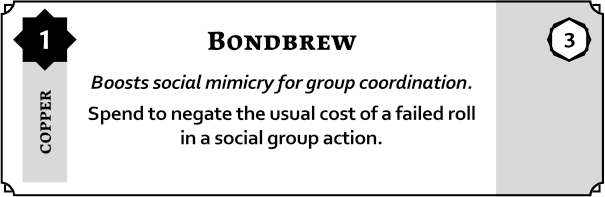
Power Cards
Each power is printed on a single card. A player should hold all cards that form their archive, but store the ones not in use.
The number in black is the Power’s Tier, which rates from 1-4.
Tiers 1–2 appear subtle or mundane.
Tiers 3–4 look openly supernatural or overt.
The vertical grey banner indicates which of the calling’s paths this comes from.
The number in the white circle in the top right is the number of uses it has before it becomes exhausted.
Once exhausted, the player may not use this ability until it is refreshed.
When a power is put into the sideboard, place this number of tokens in the grey area. Whenever it gets used, simply spend a token.
If a given power only makes sense if certain fictional prerequisites have been met (a potion has been drunk, or a rig is mounted on a wearer, or a spell is performed to music), then this should be resolved in the fiction. The tokens are simply to track total uses, rather than manage the specific realisation of that power.

Exemplery
Excellence turned into action. Exemplery is tied to the Adept class and represents the augmentation of their abilities through a mythic archetype. A single power for an Adept is known as a feat. Each Adept’s foundation is divided into four disciplines, which links to a specific Action.
Adepts do not prepare feats.
During Play, an Adept can add any feat from their library to their sideboard, if they have space.
Once the limit is met, no feats may be added until one or more is cleared.
Adepts cannot refresh their feats. Once exhausted, a feat remains exhausted until it is cleared.
- During a short rest, they can clear any single Tier 1 or 2 feat.
- During long rest, they can clear any single Tier 3 or 4 feat, or any two Tier 1 or 2 feats.

Liminance
Bold theory made real. Liminance belongs to the Luminary class and channels volatile logic into practical effect. A single power for a Luminary is called a tech. Each Luminary foundation is divided into four fields, each field drawing on a signature principle that shapes a different style of tech.
Luminary can prepare techs during Stay, up to their limit. They can prepare techs from their library OR archive.
- During a short rest, they may prepare any Tier 1-2 techs.
- During a long rest, they may prepare their Tier 3-4 techs too.
When a tech becomes exhausted, the Luminary can refresh it by paying an amount of Supply equal to the Tier of their chosen tech.
Optionally, they may replace it with any another Tier 1 or 2 power from their library, and paying the Supply equal to the Tier.
Luminaries can prepare techs from their archive as improvised techs.
To prepare an improvised tech, they must pay an amount of Supply equal to its Tier, and only with half of its uses (rounded down).

Magic
Reality rewritten through art. Magic belongs to the Mage class and reshapes the world through symbolic craft. A single power for a Mage is called a spell. Each Mage foundation is divided into four arts, each art allowing the Mage to express the their style of magic through a different facet.
Mages can prepare spells during Stay, up to their limit. They can prepare spells from their library OR archive.
- During a short or long rest, they may prepare spells of any Tier.
- At least half of their prepared spells must be Tiers 1 or 2.
When a spell becomes exhausted, the Mage can refresh it by paying an amount of Flare equal to its Tier.
Mages can prepare spells from their archive as improvised spells.
To prepare an improvised spell, they must pay an amount of Flare equal to its Tier.
The player must also place a danger die on the card, which is rolled on any Actions relevant to that spell.

Theurgy
Miracles shaped by devotion. Theurgy belongs to the Theurge class and allows the Theurge to draw down the powers of their principle into the mundane world. A single power for a Theurge is called a boon. Each Theurge foundation is divided into four domains, each domain which represents a different purview of influence their principle can govern.
Theurges can prepare boons during Stay, up to their limit. They can prepare boons from their library.
- During a short or long rest, they may prepare boons of any Tier.
- At least half of their prepared boons must be Tiers 1 or 2.
When a boons becomes exhausted, the Theurge can refresh it by paying an amount of Flare equal to its Tier.
Theurges can add boons from their archive as gifted boons, but not as part of preparation.
During a short rest, they may use their downtime activity to add a Tier 1 or 2 boon from their library or archive.
During a long rest, they may use their downtime activity to add a Tier 3 or 4 boon from their library or archive.
The player must also place a danger die on the card, which is rolled on any Actions relevant to that spell.
 Morningstar Fables